World Building Lesson 6 – Real Talk

Hello Writers!

Happy Sunday to you!

Language is a touchy subject for a lot of writers. When creating a world it’s easy to get lost in the cadence and flow of your words. Likewise, it’s easy to be pulled by the siren song of making your world unique. So unique, in fact, that you start using or making up foreign words. Especially if you are writing in the genres of science fiction or fantasy where there may be characters who are not human.

LanguageHowever, very few writers can actually pull off using made up words, or phrases in another language. The proper way to do it is to reveal the English equivalent immediately after the foreign word or phrase:

“It’s the Diablo Furca,” he explained, “the Devil’s Fork.”

Providing the English translation allows your reader to understand what’s being said without an interruption in their reading flow.

That being said, if there is a concept or item that has no English equivalent, it’s ok and expected almost that you would create a word or phrase to convey the meaning to your readers. However, you need to explain the meaning, not just use the phrase and expect your reader to know what it means or get the gist of what you’re trying to get across.

It also bears mentioning that if you use a foreign language that is a real language, make sure to use it correctly and accurately so you do not alienate your readers who speak and read that language. even worse than confusing your readers with words they don’t know is using their native language wrong or unknowingly insulting their culture.

Another important thing to remember in regards to language is to use names and words that can easily be pronounced by the average English speaker, If you use words made up of a strange combination of letters and punctuation (i.e. Lotz’zun, P’orgen’to, DeS’alvzentch, etc.) you will cause the reader to take a step back and remember they are reading words on a page, not witnessing a story unfold before them. It is jarring and disruptive to the reader and their experience with your work.

All this leaves the discussion of jargon and dialect. Some writers make up or use existing location or cultural slang dialect or phrases in their writing. Few authors can really pull this off without sounding trite or insulting or both. If you’re not really good at writing dialect or jargon and think it would really add to your story, read some books that do dialect well such as Anthony Burgess’s A Clockwork Orange. You can also study some techniques for using dialect and good dialogue in books like James Scott Bell’s How to Write Dazzling Dialogue. If you’re ever in doubt whether you should use jargon or dialect in your work, you probably shouldn’t.

Here’s an affiliate link that helps me keep this page going, thanks for your support:

A Clockwork Orange

How to Write Dazzling Dialogue

~ Eileen

World Building Lesson 5 – Making History

Hello Writers!

Happy Sunday to you!

WhysWhen a writer sits down to write, he might begin by making up a character. This character will have a name, a job, a physical description, probably a hobby or two, and some friends. This is a two dimensional, superficial character. There is not a lot of depth.

To truly connect with a character, the reader needs to understand the whys of who they are. Does your character live where they live because they grew up there? Because they took a job there? Do they love the town? Hate it? If they hate it, why do they stay?

If your characters are not human, what do they look like, what drives them, what do they most desire? Why are their eyes big? Is their planet dark? Why? Answer all the why questions your readers might as as they read your work. Randomly joined actions never come across as they would if they were well thought out; because they aren’t.

A character’s history builds who they are. readers connect with their past tragedies or current joys. There is no real connection built with blond hair and green eyes. It’s the character’s whys that create a bond between your story and your reader. It adds the depth needed to make your character three dimensional, real.

To be clear, a character’s history is not always revealed in a story. Sometimes pieces are leaked out as they become important to the story or to set the story up for something that happens later on. Knowing your character’s history makes you better able to represent them in the story.

For example, say your characters are heading to a basement because a tornado is coming. One of your characters, Stacey, is reluctant to enter the basement and has to be drug inside to avoid harm. She continues to become more and more agitated the longer she is in the basement.

Your reader, should they notice Stacey’s behavior, will be drawn in and begin to wonder why she is acting the way she is. As the writer, you know that her babysitter used to lock her in the basement for hours at a time when she was little. you may never reveal this information in the story, but you KNOW it. You know Stacey’s terror of being in the basement is very real and so you are able to write the scene in a very believable and relevant way.

Whatever it is your characters are afraid of, you know why. Knowing the WHYs will allow you to tap into your characters and write them with an authenticity you would not otherwise have. To give your characters enough depth to be three dimensional, you must answer their whys for yourself.

I love writing short back stories for my characters. Even if I never use them. It allows me to feel like I know them really well. More importantly, knowing the character so well helps me write them in a way that is true and authentic to who they are as an individual.

Do you write back stories for your characters? What’s your method for creating a history for your characters and places? Let me know in the comments below!

Here’s an affiliate link that helps me keep this page going, thanks for your support:

The Elements of Style, Fourth Edition

~ Eileen

World Building Lesson 4 – Breaking the Rules

Hello Writers!

Happy Sunday to you!

Today’s post is on making rules for your world. Now, when I say your world must have rules, I don’t mean ‘No pushing on the stairs.’ or ‘No picking your nose where others can see you.’ (Although a story in a world with those rules could get interesting!). I mean rules about how the world your characters will move around in operates.

Photo by: svklimkin

Photo by: svklimkin

A world needs rules and laws of nature to become three dimensional. For example, if you were writing a story that takes place on another planet than Earth, the reader would need to know what sort of world the story takes place in. Is there gravity? Oxygen? Can inhabitants grow a garden? Eat the wildlife? Is there a water source? Are there planet natives? If so, how do your characters interact with the natives?

In order to become immersed in the story, your readers need to know what they’re dealing with. The reader needs to understand this unknown environment. They need to know what can and can’t happen, what they can expect. The reader won’t know about the world you created until you open it up for them and tell them what they need to know.

You may wonder why you have to figure out all this information before you even begin to write your stories. The answer is consistency. You need to define the boundaries and make sure your characters stay within those boundaries or explain to the reader why the rules don’t apply to that particular character.

In addition to consistency, making your world rules clear and documented from the beginning will help ensure you don’t get confused later on and create conflicts in your stories. Your readers will call you out on it, I can guarantee it!

If you’re writing science fiction, you may want to establish rules around space travel, for example. This might include things such as what happens if you fly into a black hole, what are the effects on someone traveling at light speed, what kind of fuel do the space ships use, and how does cryo-travel work?

The purpose of rules is not to write them all out in your stories and bore your reader half to death. The purpose is so you, the writer, have the world and how it works clear in your head so your characters don’t violate any of the rules of the world on their adventures.

If you’re writing a book that includes time travel, you’ll want those rules laid out. Time travel can get pretty sticky!

Some other rules you might consider, depending on your story’s genre are Magic Rules. Remember that each rule should have consequences. There is always a price for using magic or traveling through space and time. What makes the cost of these activities worth the risk of the consequences? That is where your character’s goals come in. His desire to accomplish his goals make the risk acceptable to him.

What are your thoughts? What rules will you create for your world? Let me know in the comments below!

Here’s an affiliate link that helps me keep this page going, thanks for your support:

Wonderbook: The Illustrated Guide to Creating Imaginative Fiction

Kobold Guide to Worldbuilding

~ Eileen

World Building Lesson 3 – How to Get Ideas

Hello Writers!

Happy Sunday to you!

There is really no ‘right’ way to come up with story ideas and concepts. Sometimes a story idea will come to you when you’re reading something. As long as you’re not copying the work of another writer, it’s perfectly ok to get inspiration and ideas from the works of others. Other times, you could have an idea just come to you from out of the blue while you’re doing something completely unrelated to reading or writing!

Picture By: Domas

Picture By: Domas

For example, my Chosen series all stemmed from a prompted short story I wrote over a decade ago that I never did anything with. In the short story, the main character, Marcellus, was involved in a trial of some kind and he was hiding in some bushes that had thorns. Marcellus was dripping blood on the ground and that’s how he was discovered by the Master conducting the trial.

That story struck me and it stewed in the back of my mind for years. That scene, where Marcellus hid behind the thorny bushes, trying to control his breathing, his heart pounding, it was one that stayed with me until I knew it would be a book. In book one of the Chosen series, Time Chosen, Marcellus does go through a trial and hide behind a thorny bush.

My Chosen series has been the work of many years. I have planned and outlined, written and edited, draw maps, done character creation exercises and so much more to make a world. As I worked through these exercises, a world emerged. One where I could write more than one book. A series was born in my mind. As I worked on that series, another region of my world emerged and suddenly I had two book series planned. These ideas expanded until I had 8 series planned of 5 books each and a slew of short stories planned.

All of this came from one scene in a short story I wrote over a decade ago!

Story ideas are everywhere. I carry a notebook and pen everywhere I go. I jot down things that seem terrible or things full of beauty. Conversations and people, scenes and places; all of these could find their way into my notebook and maybe even into a story a month from now, or years from now.

The good news is ideas for stories are all around you. People watching can give you some great material for creating a character, for fleshing out a character, or even creating a character sketch. Why is that woman alone? Is she waiting for someone? Who could she be waiting for? Why is she wearing a red flower in her hair? Is she meeting a blind date? Maybe she’s a spy! What mission is she on? Start asking questions about everything you see and soon a story will appear where there wasn’t one before.

Look back at some old stories or poems you may have written. Seek out pieces that are intriguing or especially good and ask yourself if you can expand it to make a longer piece, a novella or even a novel. Ask questions about the piece to help you expand it. Use writing prompts to get your ideas flowing. There are some affiliate links to writing prompt books that I like below.

Do you have a good source of ideas? Let me know in the comments below!

Here’s an affiliate link that helps me keep this page going, thanks for your support:

The Writer’s Lab: A Place to Experiment with Fiction

The Daily Writer (free if you have a Kindle Unlimited subscription)

Happy Writing!

~ Eileen

World Building Lesson 2 – Organizing Your World

Hello Writers!

Happy Sunday to you!

Let’s talk about organizing our world information. I use binders, but you can use whatever method speaks to your creative side.

I have a binder with dividers where I keep all the information about my world. I call it my Chosen Bible (my series is called The Chosen). I have tabbed dividers inside. One tab is for maps and geography information. I have a glossery for non-English termas and their meaning. I have a tab for character sketches and basic information about them. Another tab contains story outlines. This Bible binder is one I go to again and again to write in new information or reference something for a story or book. If I’m going to be writing away from my home office, I can grab my Bible and head out.

Photo by: Ladyheart

Photo by: Ladyheart

I have another binder for book outlines and story arcs. Another binder is for characters. Each book, as it’s finished, gets printed and put into its own binder for editing and beta reading. I have other binders for other topics as well. The point is, I have a system to organize my information. You should have some sort of system to organize your series and/or book information as well as information about your world(s).

You may think this is starting to sound like a lot of work. Guess what? It IS a lot of work! But anything worth doing is worth doing right. If you’re serious about creating a world and writing books and stories and making a career out of this world, then it will pay off in the long run to do it correctly from the very beginning so there are not ugly surprises later when you call someone a wrong name in your work or reference a city that is nowhere near where the action is happening. Keeping things organized will keep you out of trouble with your writing.

I recommend three ring binders for your world and series organization efforts. If you buy them at a bulk store, they are very affordable. You can put dividers int hem to break up the contents into sections. You can also remove and add pages wherever you want. Binders are wonderful, magical organizational tools.

When creating your world, you will always want to leave room for expansion. A misty edge where no one has gone before but legends say there are horrible monsters beyond your wildest imagination past the mists. Leave a body of water where what’s beyond the water is unknown. Binders allow you to put in new pages, and keep things neat and easy to find later when you need to reference them.

If you already have some stories or books written, when building your world you will want to put in all the places that have action planned in your works. The other part is to put in some towns and places that don’t have any action yet. So you can build more action in later if you want or need to. Sketch out maps to help you stay oriented and know the correlation between one location and another. Sketch street scenes if you like to draw, or find pictures online that represent what you think the city or town might look like. Print those out and put them with your location information. It’s nice to have a visual when you are writing about a place.

Plan ahead. When I started my Chosen series, I knew I would have eight realms with five books in each realm. I also knew which minor characters would get their own short stories. I planned it out to create interest in the Chosen books and to have an endless supply of writing ideas.

Think about how you want to organize your world and series information. Get your binders, notebooks, file folders, or stacks ready and join me next week when we will talk about how to get an idea for a world.

Here’s an affiliate link that helps me keep this page going, thanks for your support:

Three ring binders – set of 4 on Amazon

Happy Writing!

~ Eileen

World Building Lesson 1 – What is World Building

Hello Writers!

Happy Sunday to you!

Today I want to talk about my project a little bit. I’m building a world. I am a god! 🙂 Just kidding. Seriously though, how do you create a whole world? It’s a little overwhelming if you stop and think about it.

There are realms and regions, maps, rules, lore, and so much more! (Hey, that rhymed! Totally unintentional. But I digress.)

Picture by: lauramusikanski

Picture by: lauramusikanski

Some of you may know that I’ve been working on a series of books for a few years now. While I’m writing the stories, questions come up about all sorts of things like, what religion do these characters believe in? Are they human? Do they believe in some sort of afterlife? What happens if the species interbreed? So many things to decide for these characters I’ve created. Not answering these questions leaves my characters and my world two dimensional; lacking depth.

As a love of Sci-Fi and Fantasy myself, I know what it’s like to read something that contradicts itself or goes against its own rules. As a reader, you feel cheated. For me, it’s like the writer thinks I’m dumb and I won’t catch the error.

In reality, the writer probably forgot their own rules or didn’t remember the character had green hair instead of blue a few chapters back. It’s simply overlooked. I’m sure writers who make these errors would be mortified to find those mistakes in their own writing.

I’m a pretty good Internet researcher, but I had trouble finding information on creating worlds. So, I’m going to take you on this creation journey with me in the hopes that my discoveries are helpful to you. Along the way, if you have questions or suggestions, please speak up. I love to collaborate instead of just talking to myself all the time! 🙂

By the way, I will post affiliate links from time to time. It earns me a little cash and allows you to find some cool products.

So, how is a diligent writer supposed to keep everything straight with their world and characters without tripping all over themselves or making a mess of the whole effort?

One word. Organization.

Stay tuned! Next week, we delve into organizing our world information and materials.

Here’s an affiliate link that helps me keep this page going, thanks for your support:

Orson Scott Card’s Writing Fantasy & Science Fiction

Happy Writing!

~ Eileen

Writing Resource: Random First Line Generator

If you’ve been following me for a while, you know I like to use random generator tools to spur ideas for quick and spontaneous writing. Some people find it difficult to think of something to write when they are under pressure even if it’s self-imposed pressure. However, I find doing writing exercises regularly that are prompted by a random generator of some sort keep my writing skills sharp. I can pretty much write something worthwhile at the drop of a hat now. All it takes is some regular practice.

Today’s resource that I would like to share with you generates an entire line randomly when you click the button. It’s on the Writing Exercises website which you can find HERE. There are several generator tools to choose from and they are all pretty great. For example, from the home page, you can select a Random Quick Plot Generator. When I used that tool, this is what I got.

QuckPlotGenerator

Right away my mind begins spinning off into the setting for the opening scene in which my young man is standing on a cliff ready to jump, the wind whipping his blond hair off his forehead to reveal his royal blue eyes and the police are after him. Then there is a ‘4 Days Earlier’ transition into the meat of the story. I can’t wait to write it!

One of my favorite tools on this site is the Random First Line Generator. This tool just gives you the first line of your piece and then you’re off! I like to use generator tools in conjunction with my Write or Die Desktop Edition (there is a free web app version too). I set a time or word limit and pound away on my keyboard until I hit my set goal. Sometimes I stop there and sometimes I keep going. Other times I set it aside so I can think about it and add more to it later. Whatever you decide to do with your piece of writing, it’s an excellent way to get your juices flowing.

Here’s what my First Line came out as:

FirstLineGenerator


And here’s what I wrote in 5 minutes. (This is completely unedited.)

# # # # #

There was nothing left of the money except what lay on the table. Hank looked at the paltry stack of bills and felt his anger rising up into his face. He took a deep breath and trained his eyes on Marney.

“This is it?” He tried to control his fury, but it seeped out through his teeth like smoke.

She nodded silently, afraid to meet his eyes.

“Look at me.”

Her head came up inch by inch, her fresh shiner a grim reminder that Hank was back home and he was in charge. Her arms twitched, grabbing onto each other for comfort, her hands flitting up and down her too thin arms like dying birds.

“This is all that’s left?” He growled at her.

“Yes.” She said, tears leaking from her eyes. She nodded. “Yes. That’s all.” She waved a small hand at the paper on the table.

The silence was pregnant with unpent rage.

“There were bills, Hank. ” She stammered. “And Malorey . . . needed school . . . clothes and supplies . . .” Her voice trailed off, knowing Hank didn’t care about what their daughter needed to raise above the filth and poverty they both had grown up in.

“Damn it, Marney. I needed that money!” He yelled, slamming his fist onto the formica table top.

The paper bounced once and rolled over onto its side before it fell with a plop onto the kitchen floor. Before Marney’s eyes could get from the money on the floor to Hank’s face, she felt his fist pound into her cheek.

She opened her eyes. The money was inches from her face, his boots were coming closer and Marney began to cry.

# # # # #

I like to use generators and a 5 minute timer on my Write or Die to get myself warmed up. Then I get to work on my novel. Or sometimes, I use the generator as a blog post topic AND a writing warm up to boot!

Happy Reading and Happy Writing!

~ Eileen 🙂

Using Cards to Outline Your Story

Story Cards

When I am writing something, whether it is a novel, a series of novels, or a short story, I like to outline things first. Outlining is a way to organize your thoughts and theories and keep yourself motivated throughout the story. Outlining also helps you keep on topic and not go off on a tangent that does not contribute to the story as a whole. Sub-plots are ok, but can be cumbersome if they get away from you.

There are many ways to outline your story. Some people prefer the traditional method of roman numerals and indented numbers on a piece of paper. That works and is totally fine. I don’t use that method, myself, because if I want to move something around in my outline, it is difficult to do so with an outline written on paper. Another way to do your outlining is with cards. These can be index cards, cardstock you cut into pieces, or any other method you like. The idea is to write one idea on the card, just like you would for one line item in a paper outline. Once you have some ideas written down, put the cards in the order they would appear in the story.

For example, a very simple story outline in the traditional method might look like this:

TOMMY GOES TO THE STORE

I. Tommy decides to go to the store

A. Tommy gets his shoes on

1. Tommy can’t find his wallet

B. Tommy searches house for wallet

2. He finds a gun under his brother’s bed


And the outline could go on and on. But for demonstration purposes, I’ll stop there. As you can see, one major story idea is on each line. Now, with story cards, each of the lines above (except for the title, really) would go on its own card. Then I would arrange them in the order I want them to appear in the story, just like the order shown above with the traditional method.

Now let’s say as I work with the story, I decide that Tommy needs a reason to go to the store, so I want to add something to the top of my outline. If I have this all written down on a piece of paper in the traditional method, I now have to rewrite the outline, write my new idea below with arrows pointing to the top of the outline, or do some other awkward things on paper to indicate where I want the new idea to fit into the outline. Using story cards, I can just write the new idea on a card and insert it in the front of the cards where I want the new idea to appear in the story.

There are many outlining tools, books on outlining stories, and other resources available in the world. In fact, if you Google ‘story outlining tools’, you’re likely to find a big list of free resources, articles, and recommendations on the web. There are tons of technology applications created for writers that allow you to use a virtual method for outlining and story carding.

I use two tools that I absolutely love. Now, I’m a geek, so I prefer technological tools. (I do use pen and paper when I’m not around a computer.) I use the writing software Scrivener for most of my writing. Scrivener has a card tool that I love to use when outlining my stories. You can put ideas on cards, view the corkboard and drag them around to rearrange things, add or delete information from the cards if you like, color code the cards, and other functions. Here’s what the Scrivener story board might look like if I used it for the example above.

Scrivener Story Cards Demonstration

Scrivener is available for both Windows and Mac users. You can get more information about Scrivener on their website, here: Scrivener Website

The other tool I like to use is on my iPad. While Scrivener is a full-service tool that allows you to outline, write, export, print and organize your writing pieces, this tool is just for story carding or outlining. It’s called simply, Index Card and is available through iTunes. At the time I’m writing this article, the application is $4.99 USD. You can read about the features and purchase the app here: Index Card App

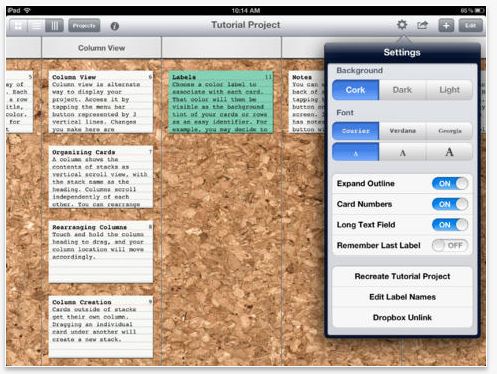
It’s excellent for outlining on the go. If you have Scrivener for the Mac, you can sync your Index Card work with your Scrivener app. You can print an outline from the Index Cards app, create a color coded visual outline document, and other cool features.  Here’s what a sample screen in the Index Card App looks like:

Index Card Sample


No matter which method or tool you use, outlining is an excellent way to keep you organized and motivated in your story.

Happy Writing!

~ Eileen 🙂

Resource Saturdays: NaNoWriMo

NaNoWriMo

November is National Novel Writing Month! I know when I first started getting back into writing, I didn’t know where to begin. I wanted writing prompts and advice, outlets and ideas and among my searches, I kept seeing people talk about ‘NaNoWriMo’ and I had no idea what it was! Through some additional research, I finally figured out what it was and how useful it can be in helping me complete a novel in just one month. Although today is day 2 of NaNoWriMo, I wanted to share it anyway in the hopes of helping someone get a burst of inspiration. You can join at any time, so don’t let anything stop you!NaNo Shield

What can NaNoWriMo do for me?

NaNoWriMo, or NaNo as most people refer to it, has many resources, boards, local groups and other resources to help you along your novel writing journey. Joining NaNo is free and allows you access to all of the NaNo tools and information.

During the month of November, there are daily posts with inspiration from other writers. Some of them are even famous writers. For example, the day 1 pep talk post was from James Patterson. Here’s a blurb to prove my point. This is not the whole Pep Talk post from Mr. Patterson, you’ll have to join NaNo to read the whole thing! 🙂

James Patterson Pep Talk

Your Author Dashboard allows you to track your novel, post information about your book and yourself, track your word count, earn badges and other things that keep you motivated and involved in writing your novel. You can create groups where you post your work, get feedback, and encourage one another to KEEP WRITING!

Here’s my Dashboard:

NaNo Author Dashboard

You may notice there are several tabs across the top of my dashboard, Author Info (showing), My Novels, Writing Buddies, Buddy Of, and Stats. Each of these tabs is available for free to all members. You can add writing buddies so you can send messages to each other, offer encouragement, or complain, whatever you need to say!

If you want to add me as your NaNo writing buddy, just search for ‘eileenmaki’ and you can add me!

Across the top of the screen in the above shot (brown menu bar) you can access the NaNo store where you can purchase goods or make a donation to NaNo. You can also find local NaNo events and join others in your area for a ‘Write In’ event or get together.

So what are you waiting for? Head on over to NaNoWriMo.org and get started. Once you have an account, or if you already have one, add me as a Writing Buddy and let’s get those novels written!

Happy Writing!

~ Eileen 🙂

Resource Saturdays: Poets and Writers Classifieds

Hey There!

Are you guys all ready for Halloween? It seems like it sneaks up on me every year! On to the Resource! 🙂

While looking for submission calls, I stumbled across an oldie but a goodie. The Classified ads on the Poets and Writers website. They have lots of open calls for various markets and listings for groups, etc. It’s a pretty good place to check out once in a while.

Poets and Writers Classifieds

The Classifies page has some different categories to choose from: Manuscript Calls, Conferences, Contests, Publication, Retreats, Residencies, Resources, Services, and Workshops.

PoetsAndWriters1

Once you make a selection, you can peruse the ads and choose options to pursue. The Contest section is my favorite. It’s got tons of resources to choose from. Check it out and let me know what you think.

The information is updated regularly, so I recommend you book mark it, or visit my Resources Page for the link at any time!

Happy Writing!

~ Eileen 🙂